Imagine if Apple built the iPhone, simply made a website, and hoped people would magically stumble across it. All this without demos, ads, or keynotes. It becomes a great product just waiting to be discovered.
It would have flopped.
Yet, this is exactly how most freshers approach their first job. They spend years earning a degree, write generic resumes, and send that one resume to 100 job openings irrespective of the role.
After that, the wait begins.
But in 2026, waiting is a losing strategy. With the integration of AI, writing resumes has become effortless, which means recruiters receive 100 resumes with the same keywords. Application volumes have increased exponentially, but the average recruiter spends only a few seconds reviewing each resume.
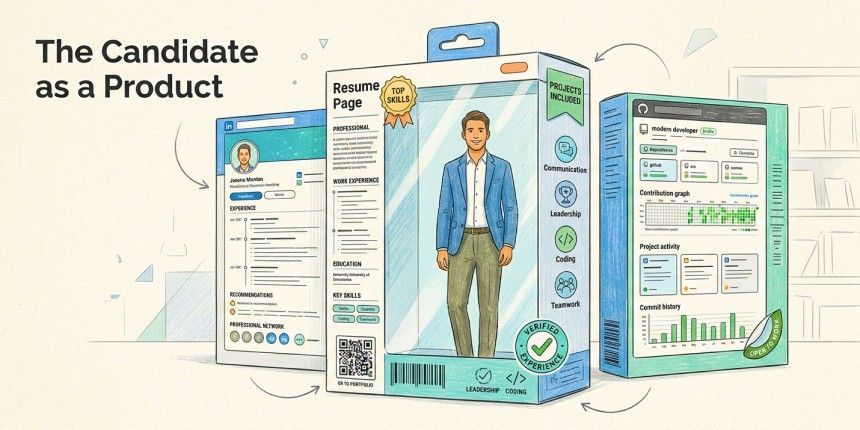
Qualifications don't make a candidate stand out anymore. They need to position themselves like a product for a recruiter to invest interest in them.
So here is how you can launch yourself like a product and land your first job in 2026.
Build Skills Before You Build a Resume
Before anything, you need to invest in skills recruiters look for. No amount of clever marketing can save a weak candidate.
So before obsessing over font size, invest in the main thing recruiters are looking for: a candidate's ability to do the work. This means industry-relevant skills, real-life experience, and the ability to work with AI. Additional certifications that add further credibility will also be useful.
This is not a simple hunch. The World Economic Forum’s Future of Jobs Report 2025 found that more than a candidate's qualifications, recruiters look for their analytical skills, their resilience, flexibility, their ability to keep learning, and their AI literacy. It is no longer enough to have one skill alone. Candidates are expected to constantly level up to thrive in the workspace.
So build the skills and get hands-on experience before you can even begin working on your resume.
Package Yourself So You Stand Out
Even great products can fail if no one even knows it exists. How you package yourself is what creates value in that first impression.
Start with your resume, because it is what most recruiters see first. Keep it simple, organized, and scannable while being ATS-friendly. Indeed’s Career Guide is a solid reference on how to structure a resume that looks good to recruiters and is ATS-friendly. The main point is to match job description keywords, pinpoint their outcomes, and make sure everything that is on the resume is necessary.
Then look at LinkedIn, because recruiters increasingly search there before they open your resume. A complete, keyword-rich profile with a real headline and a human summary does more for you than most people realize. LinkedIn's own help resources walk through how profiles surface in recruiter searches, which is worth understanding if you want to be found rather than found by accident.
For technical roles, your GitHub is part of the packaging too. A tidy repository with a readable README and a project that actually runs says more than a bullet point ever could. The GitHub blog is a good place to see how developers present their work and what a strong public profile looks like.
Here is the mindset shift that makes all of this click: your resume does not get you hired. It earns you the next conversation. That is its entire job. Once you stop asking your packaging to close the deal and start asking it to open a door, everything gets easier.
Get Visible: Marketing Beats Applying
This is where most freshers quietly lose the game, because they believe a comforting lie: good candidates get discovered.
They do not. Visible candidates get discovered.
A brilliant product with zero marketing stays invisible on the shelf, and so does a talented graduate who does nothing but submit applications into the void. The uncomfortable truth is that a huge share of hiring never runs through the front door at all. It runs through people. Referrals, alumni networks, and warm introductions consistently outperform cold applications, a pattern that shows up again and again in LinkedIn's own workforce data at its Economic Graph and in the hiring trends it publishes through LinkedIn News.
So market yourself the way a small brand builds an audience: steadily, and in public.
- Show your work. Post about what you are learning and building. You do not need to go viral. You need a few of the right people to notice.
- Use your network before you need it. Reach out to alumni, ask for referrals, and treat every conversation as a relationship rather than a transaction.
- Go where the work is. Hackathons, open-source projects, and online communities put you in the same room as the people who hire.
None of this requires being loud or fake. It requires being present. A candidate who is visible, active, and easy to remember beats a stronger candidate nobody has heard of.
Treat the Interview Like a Product Demo
Somewhere along the way, someone told you an interview is an exam. It is not. It is a product demo.
By the time you are in the room, the recruiter already knows your resume. They are not there to re-read your qualifications. They are there to see the product work. Can you think clearly under pressure? Can you explain your reasoning? Can you solve a real problem, and can you do it with other people?
Treat the interview like a live demo, and prepare like one. Have a few stories ready that show, not tell. The STAR method, which structures an answer around Situation, Task, Action, and Result, is a reliable way to turn a vague memory into a sharp, memorable example. Practice out loud, ideally with mock interviews or an AI interviewer, because the gap between knowing an answer and delivering it well is wider than most people expect.
There is a psychological layer here worth understanding, and the Harvard Business Review is a rich source on it. Interviewers are not just scoring answers; they are forming an impression of what it would be like to work with you every day. That means the questions you ask matter as much as the ones you answer. Thoughtful questions signal curiosity and seriousness, and they flip the demo into a conversation between two people deciding if they want to build something together.
Turn Every Rejection Into Feedback
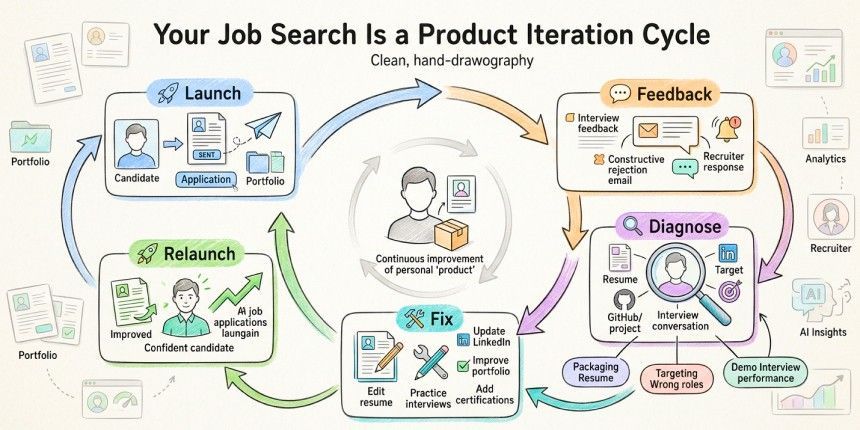
Every product launch that ever mattered got feedback and shipped a better version. Your job search should work the same way, which means reframing the single most demoralizing part of it.
A rejection is not a verdict. It is customer feedback about your launch.
Instead of thinking "I got rejected," ask which part of the launch fell short. The pattern in your results usually tells you exactly where to look.
- No interviews at all? That is a packaging problem. Your resume and profiles are not landing.
- No callbacks after applying widely? That is a targeting problem. You may be aiming at the wrong roles or the wrong companies.
- Interviews that go nowhere? That is a demo problem. The story needs work, or the delivery does.
Diagnose the failure, fix that one thing, and launch again. This is the difference between a fresher who applies to two hundred jobs on repeat and one who applies to twenty, learns from each, and gets sharper every week.
Your Career Is a Product in Progress
Here is the thing about products. Almost none of them get it right on version one. They ship, they listen, they refine, and the version that finally finds its market looks very different from the one that launched.
Your career is no different.
So stop measuring success by how many applications you send. Measure it by how much better your product gets every single week. Build it. Package it. Market it. Demonstrate it. Improve it.
That is how freshers get hired faster in 2026, not by applying harder, but by launching smarter.
Frequently Asked Questions
1. Do I need work experience to get my first job?
Not necessarily. Internships, freelance projects, open-source contributions, and personal projects all count. Recruiters want proof you can do the work, not just a job title.
2. How many jobs should I apply to?
Quality over quantity. A targeted application to 20 well-matched roles will outperform mass-applying to 200. Tailor each one.
3. Does my LinkedIn profile actually matter?
Yes. Recruiters search LinkedIn before they even open your resume. A complete, keyword-rich profile makes you findable without you having to do anything extra.
4. How do I handle rejections without losing motivation?
Treat each one as data. No interviews mean, fix your resume. Interviews but no callbacks means, fix your targeting. Callbacks but no offers means, fix your demo. There is always a next step.
5. I have no network. How do I start building one?
Start with your college alumni. Reach out genuinely, ask questions, and offer something in return where you can. A warm conversation beats a cold application every time.